
Introduction
Once you have worked out that a generator might be useful, the next obvious question is: what size generator do you actually need?
If you have not already, have a look at my earlier article: Do I need a generator for caravan travel?
The answer depends entirely on what you expect the generator to do.
Do you simply want to charge your batteries during poor weather? Or are you expecting the generator to run heavier appliances as well, like the caravan air conditioner?
Those are two very different jobs.
A generator that is perfectly adequate for battery charging may be nowhere near large enough to comfortably run larger appliances like an air conditioner.
In reality, depending on where you travel, you may not need a generator that often at all, for us living on the road full time we have only needed it a couple of times a year. But when we needed it, it was a life saver.
It is better to have one and need it, than to need it and not have one.
Start with the Job
Before choosing a generator size, ask yourself what role it will play in your setup.
Do you want it to:
- charge your batteries in poor weather?
- top up the batteries after a few days off-grid?
- run a few smaller appliances?
- act as a backup so you do not have to head into a caravan park?
- run the caravan air conditioner and other power hungry appliances?
- power the van like you are plugged into shore power?
Until you know that, generator size is mostly guesswork.
For Many Travellers, the Generator Is Mainly for Charging
For a lot of caravan travellers, the generator is not really about running lots of appliances directly. It is simply a backup charging source when solar falls behind.
If that is your use case, then the size of your battery charger matters just as much as the generator itself.
For example, if your van has a 40A battery charger, there is a limit to how much charging power you can actually use. In that situation, buying a large generator won’t achieve much, because the charger becomes the bottleneck.
As a rough rule of thumb, a 1kVA generator can be workable with a 40A charging system. But once charger sizes increase, you are usually better off moving up to the next generator size.
The reason for this is once the generator is plugged into the caravan, the van treats it like normal shore power.
The battery charger may already be using a large chunk of the available power, and then everything else running in the van gets added on top, fridge, microwave, kettle, lights, air conditioner and so on.
That is why a generator that seems adequate on paper can still struggle in real-world use.
Small Generators Can Make Sense
If all you want is a backup option for charging batteries, a smaller generator can make a lot of sense.
They are generally:
- easier to carry
- easier to store
- quieter
- more fuel efficient
If your main goal is simply to keep the batteries topped up after a few cloudy days to avoid being forced onto shore power, a smaller generator may do the job perfectly well.
But Air Conditioning Changes Everything
This is the part that catches many people out.
If you want to run the caravan air conditioner, then a small generator will not cut it.
Air conditioners have a significant startup load as well as a running load. Even if the generator looks close enough on paper, the startup surge can still overwhelm it.
Some setups can improve this, such as soft-start A/C, but you still need to understand the actual power demands of your air conditioner.
As a rough example, our battery monitor shows loads on the 12V side. So if the air conditioner is effectively pulling around 80A and the battery charger is also working hard, the total demand on the system climbs very quickly to beyond what a small generator can handle.
The important point is not the exact electrical conversion. It is simply that once you combine heavy loads, a small generator can run out of capacity very fast.
A generator that is perfectly fine for battery charging can be completely unsuitable for air conditioning.
We see this with our own 1kVA Honda. It handles lighter jobs fine, but it cannot run the air conditioner and charge the batteries at the same time.
What Does kVA Actually Mean?
Generator size is usually given in kVA, which stands for kilovolt-amps.
Without diving too deeply into electrical theory, the practical takeaway is simple:
The higher the kVA rating, the more the generator can comfortably handle.
A 1kVA generator is a small unit. It will be fine for lighter loads and battery charging.
To put it into more familiar caravan terms, a 1kVA generator is only roughly equivalent to around 65A to 75A of 12V power in ideal conditions. In the real world it can be less once charger losses are taken into account.
That is where people get caught. A 1kVA generator might comfortably handle battery charging on its own, but once you start adding heavier appliances like microwaves or air conditioners, you run out of capacity very quickly.
Practical Charger and Generator Matching
| AC Charger Size | Practical Generator Size |
|---|---|
| 40A charger | 1kVA – NO A/C |
| 60A charger | 2.2kVA recommended |
| 100A charger | 3+ kVA recommended |
Below is a rough guide only, it helps translate common generator sizes into 12V numbers most of us will understand.
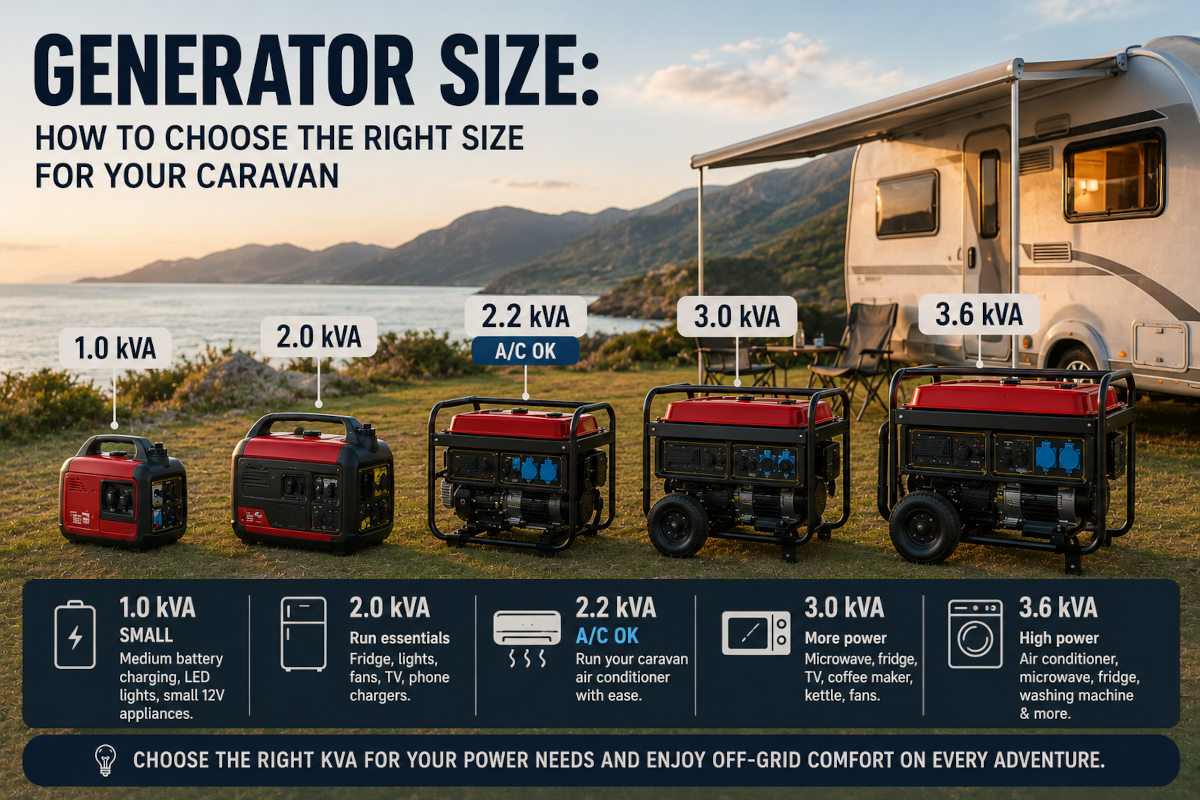
| Generator Size | Rough 12V DC Equivalent* | Typical Use | Weight |
|---|---|---|---|
| 1.0kVA | 65A–75A | Light battery charging, modest loads | 12–15kg |
| 2.0kVA | 130A–150A | Battery charging with more headroom, modest appliance use | 20–24kg |
| 2.2kVA | 145A–165A | Similar to 2kVA with a bit more margin, A/C | 20–27kg |
| 3.0kVA | 200A–225A | Heavier loads, more flexibility | 35–45kg |
| 3.5kVA | 230A–260A | Greater headroom, more suitable for high-demand use | 40–50kg |
| 15A caravan supply (240V) | About 300A equivalent | Roughly the full 15A shore-power limit | About 3.6kVA |
*These are approximate 12V-equivalent figures only. Real-world results depend on charger efficiency, generator design, power factor, and whether the rating is peak or continuous.
The Caravan Is Wired for Shore Power
Another thing worth remembering is that, from the caravan’s point of view, the generator is simply acting like shore power.
You are still plugging the van in through the normal 15A AC caravan plug, and the van is wired around that standard.
That does not mean the caravan will automatically draw 15A AC all the time, but it does mean you need to think about the total load the generator is being asked to supply.
Example
If the battery charger is working hard and then other things are running in the background, those loads all add together.
A rough 12V-side example might look like this:
- Charger = 40A
- Fridge = 5A
- Lights = 2A
- Fans = 2A
Even without doing very much, you can quickly end up around 50A worth of load.
In a situation like this, a small 1kVA generator would probably cope reasonably well because there is still some spare capacity available.
Another Example
Now let’s step things up a bit:
- Charger = 60A
- Air conditioner = 75A
- Fridge = 5A
- Lights = 2A
- Fans = 2A
That works out to roughly 140A worth of demand on the system.
At that point, a 2.2kVA generator can be getting very close to its practical limits, especially once startup surges, charger inefficiencies, and other real-world losses are taken into account.
This is exactly where many people get caught out. A generator that works perfectly for battery charging alone may struggle badly once heavy loads like air conditioning are added.
Bigger Is Not Always Better
That said, bigger is not always the answer either.
Larger generators are:
- heavier
- noisier
- less portable
- use more fuel
- take up more storage space
They can also be overkill if all you really need is a practical battery charging backup.
That is why it pays to match the generator to the job.
If the job is battery charging, buy for battery charging.
If the job is battery charging and running the air conditioner, then buy with that in mind.
Responsible Generator Use
Generators can be extremely useful, but they can also annoy other campers if used inconsiderately.
In many caravan parks there will be restrictions around generator use, ranging from limited hours through to complete bans. So do not assume you can simply book an unpowered site, turn up, and run a generator whenever you like. Caravan parks generally will not appreciate it.
A few simple things make a big difference:
- avoid running them early in the morning or late at night
- keep runtime reasonable
- think about where noise and exhaust are directed
- use efficient charging rather than running them all day
- respect generator-free camping areas
Most people do not hate generators. They hate inconsiderate generator users.
Other Practical Things to Think About
Generator size is only part of the decision.
You also need to think about:
- where you will store it
- how heavy it is to move around
- how much fuel it uses
- how noisy it is
- whether generator use is allowed where you camp
- what maintenance it needs
A generator may be a good backup option on paper, but if it is awkward to carry, too noisy, or not allowed where you stay, then it is not going to be of much use.
So, What Size Generator Do You Need?
There is no universal answer, but there is a simple way to think about it.
If you only want a generator for battery charging, a smaller unit may be all you need, depending on charger size.
If you want a bit more headroom for other loads like A/C, then stepping up a size or two makes sense.
But if your goal is running everything as if you are plugged into shore power, then a larger generator will be needed.
Final Thoughts
The right generator size depends on your real-world use case, not on what someone else carries.
For many travellers, a generator is simply a practical backup for charging batteries when solar is not keeping up. In that situation, smaller can make a lot of sense.
But if your goal is running heavier appliances, especially the air conditioner then you need to size for that job properly.
In short, buy for what you actually want the generator to do. Not bigger for the sake of it.
Thanks for reading What Size Generator Do I need. Shadow, the van, and the two of us will catch you at the next campsite.
If you enjoy this kind of content, you can sign up for the newsletter. You’ll get an email when a new post goes live (usually around 4–6 a month), plus a monthly wrap-up.

Leave a Reply