
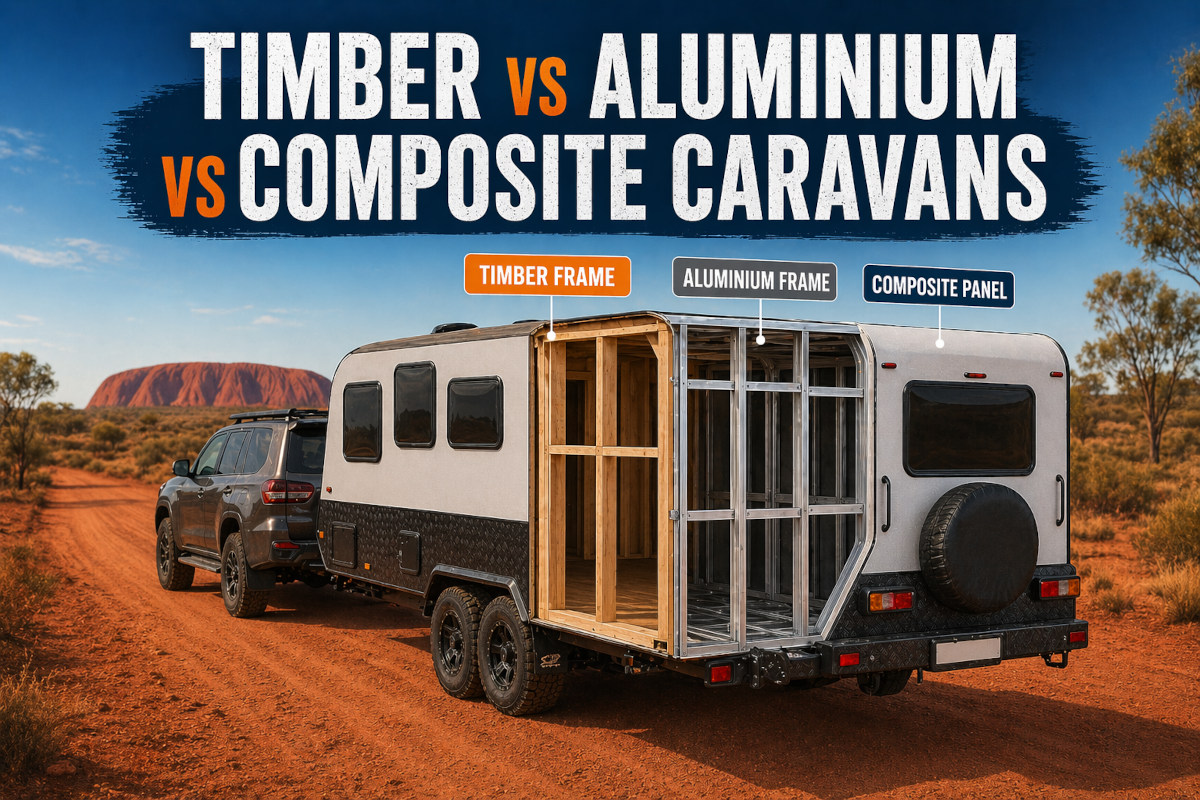
Pros, Cons of each construction type
Introduction
Before we bought our caravan, I spent a fair bit of time researching construction types. One thing kept coming up over and over, avoid timber caravans because of the risk of water leaks and rot.
While I am sure this is a valid concern, there still seems to be plenty of timber caravans being built today and I am sure there are many happy owners which have had no problems.
In the end, we went with an aluminium-framed van. What no one really talked about, though, was insulation. Aluminium might tick a lot of boxes, but when you’re parked in the sun, you quickly realise the air conditioner has to work a lot harder to keep things cool.
Like most people, we also looked at composite builds. They seem to be where the industry is heading, but for us, the price tag was hard to justify at the time.
After visiting a few caravan shows and talking to different manufacturers, one thing became pretty clear, every salesperson will tell you their construction method and construction type is the best. It doesn’t matter whether it’s timber, aluminium, or composite.
So instead of relying on sales talk, it’s worth understanding the real pros and cons of each and more importantly, what actually matters once you’re out on the road.
There’s a lot of marketing around this topic, but once you get out on the road, what really matters is how these materials perform over time.
The video below explains things really well. I’ve added our own take to it in this article, along with a few extra points worth considering.
Timber Frame
Timber-framed caravans have been around for decades and are still widely used today. Most are built using hardwoods like Meranti, although some cheaper builds may use pine.
Pros
- Easy to repair – most tradespeople can work on them
- Lower cost – generally the cheapest option
- Flexible – handles movement and road vibration well
- Proven method – long track record in the industry
- Better natural insulation than aluminium (less heat transfer)
Cons
- Water is the biggest enemy
- Can rot if moisture gets in
- Staples and glue can fail over time
- Damage is often hidden until it becomes serious
- Can be used off-road, but not ideal for harsh conditions, corrugations, water crossings, vibration and dust increase the risk of long-term issues
Real-world take
There’s nothing inherently wrong with timber, but it relies heavily on keeping water out forever. In reality, that comes down to ongoing maintenance and keeping an eye on seals.
Aluminum Frame
Aluminium framing is often marketed as a premium upgrade, but not all aluminium builds are the same. Thickness, design, and welding quality all play a big role.
Pros
- Won’t rot like timber
- Typically lighter
- Strong when engineered properly
- Seen as a higher-end option
- Well suited to off-road use when properly engineered
Cons
- Weld quality is critical
- Can crack under stress if poorly designed
- Transfers heat and cold (poor insulation, can lead to condensation)
- Harder to repair and requires skilled work
Real-world take
Aluminium is definitely a step forward in many ways, but it’s only as good as the workmanship. A poorly built aluminium frame won’t hold up any better than anything else.
Composite Panel
Composite caravans are becoming more popular, especially in off-road and premium builds. These use sandwich panels (different skins with a core), often without a traditional internal frame.
Pros
- No internal frame = fewer failure points
- Excellent insulation
- Lightweight and strong
- Fewer joins = less chance of water ingress
- Clean, modern finish
- Well suited to off-road use when properly engineered
Cons
- More expensive
- Repairs can be difficult and costly
- Poor quality builds can delaminate
- Requires precise manufacturing
Real-world take
Composite looks like the future, but only when it’s done properly. Cheap composite can actually be worse than a well-built timber van.
Head-to-Head Comparison
Here’s how they generally stack up:
- Durability:
Timber (okay) → Aluminium (good) → Composite (best if high quality) - Weight:
Timber (heavier) → Aluminium (lighter) → Composite (lightest) - Repairs:
Timber (easy) → Aluminium (moderate) → Composite (hardest) - Cost:
Timber (cheapest) → Aluminium (mid-range) → Composite (most expensive)
Final Thoughts
When choosing a caravan, there’s a lot to consider—cost, weight, and construction all play a part.
Price alone can quickly narrow your options between timber, aluminium, and composite builds, but it shouldn’t be the only factor. Weight is just as important, especially when it comes to payload.
If you’re planning a lap of Australia, you’ll be surprised how quickly the kilos add up. Between water, gear, tools, and everyday essentials, it doesn’t take long to use up your available payload. As a rough guide, having around 600+ kg of payload gives you a bit of breathing room for long-term travel.
It’s also worth thinking about how you plan to use the caravan. Will you mostly stay on sealed roads and caravan parks, or are you planning to head off-road and spend time on rough tracks? Not every construction type handles harsh conditions the same way, so matching the van to your style of travel is important.
The most important factor, though, is build quality.
A well-designed and properly built caravan will outperform a poorly built one—regardless of whether it’s timber, aluminium, or composite.
It’s also worth paying close attention to the structural warranty. Not just how long it is, but what it actually covers. A long warranty doesn’t mean much if it’s full of exclusions or difficult to claim on.
Thanks for reading Timber vs Aluminium vs Composite Construction. Shadow, the van, and the two of us will catch you at the next campsite.
If you enjoy this kind of content, you can sign up for the newsletter. You’ll get an email when a new post goes live (usually around 4–6 a month), plus a monthly wrap-up.

Leave a Reply