We came here from Hyden, with Google taking us along mostly dirt roads. Thankfully, the road was in reasonable condition, which made the drive in fairly straightforward.
Google Maps will get you to the turn-off from the Great Eastern Highway, but after that it’s best to follow the brown tourist signs, as navigation can get a bit confused. From the highway, the campsite is about 4 km in along a dirt road.
- Website: N/A
- Fee Category: Free
- Booking: No
- Powered Sites: No
- Dog Friendly: Yes
- Amenities: no
- Dump point: no
- Pool: No
- Fire Pits: Yes, fire-restrictions
- Telstra: No
- Starlink: Depends on trees
- Generator: Yes

Our Experience
This is one of those unexpected finds you come across from time to time. It’s funny how often free camps are the ones that surprise you on the upside.
You arrive not quite sure what to expect, and things turn out better than anticipated. A lot of that does come down to the weather, and for us it was dry with very little wind, ideal conditions.
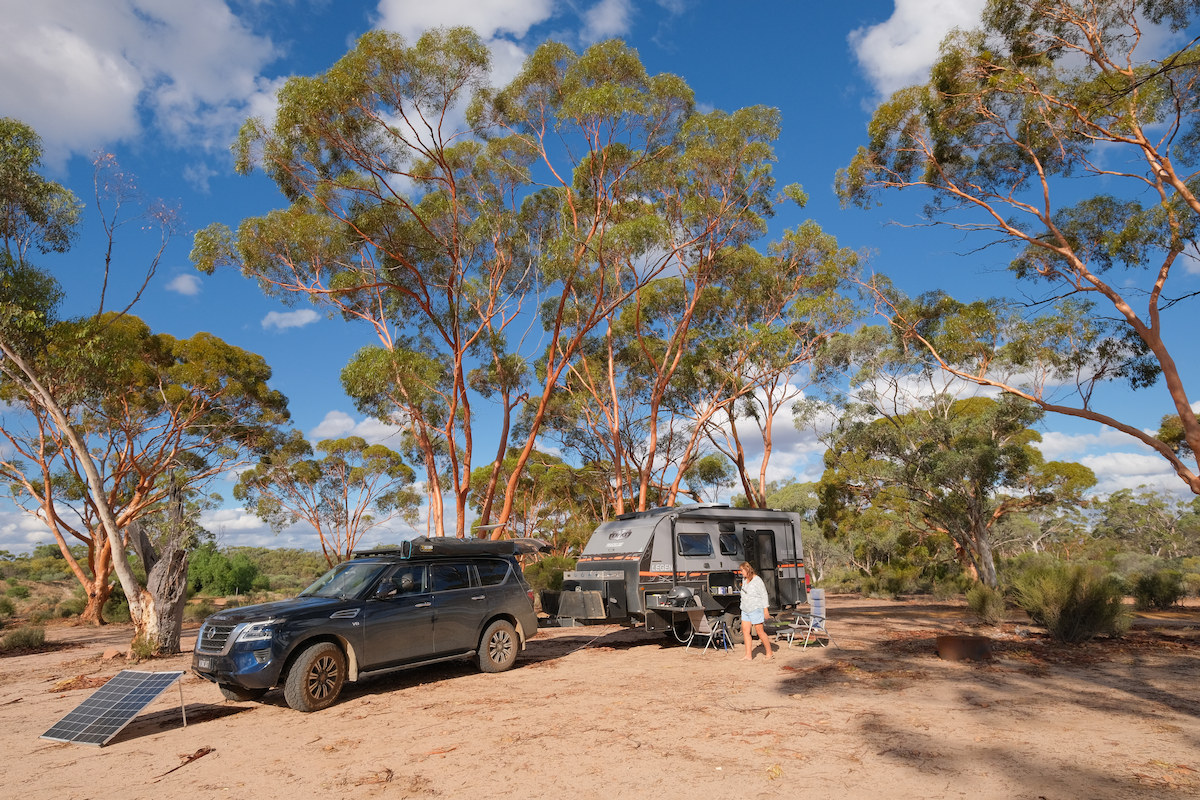
The campground itself is relatively flat, with fire pits scattered around. Unfortunately for us there was a fire ban in place during our stay.
It’s a quiet spot with next to no road noise. While there were the occasional day visitors and a few other campers, overall it felt peaceful and safe.
There are no usable facilities, which is a bit of a shame as the buildings are there but locked up, presumably due to damage. The donation box is also broken.
Because of this, you’ll need to be fully self-contained with everything you need for your stay, including taking your rubbish with you.
There’s plenty of space here, with a good mix of shady areas among the trees and open ground if you prefer to stay out in the sun.
The flies are definitely present. While they weren’t quite at plague levels when we visited, they weren’t far off, so be prepared.
The dam itself is a decent size, though whether it’s suitable for swimming is another question.
Given the dirt surface throughout the campground, I would be cautious about coming in during or after heavy rain, it could get messy fairly quickly.
What is this dam for?
The Karalee Dam is a natural rock formation adapted to maximize the catchment, delivery and storage of rainwater that was essential in railway development to the Goldfields region. It is now a popular picnic spot and camping spot on the Golden Pipeline Heritage Trail.
It is believed that Charles Hunt was responsible for the construction of a well and a dam at the base of Karalee Rocks in the 1860s. With the discovery of gold this became a regular stopping place and was officially gazetted as a water reserve in 1888. At some stage a second well was sunk.
Karalee Rocks offered an ideal water catchment area of some 71 hectares. A stone wall was erected around the base of the rocks, directing the run-off into an inlet channel. From there a steel aqueduct, or flume, carried the water to the tank. The sight of the massive aqueduct, seemingly so out of context in this environment, never fails to impress.
The Golden Pipeline
Some Pics


Summary
We would definitely stay here again. For a free camp, Karalee Dam is a bit of a standout — quiet, plenty of space, and an interesting bit of history to go with it.
You’ll need to be fully self-contained, and the flies can test your patience at times, but that’s all part of camping in this part of WA.
In good weather, this is a great spot to pull up for a night or two and enjoy a peaceful stay.
Thanks for reading Karalee Rocks & Dam – Freecamp. Shadow, the van, and the two of us will catch you at the next campsite.
If you enjoy this kind of content, you can sign up for the newsletter. You’ll get an email when a new post goes live (usually around 4–6 a month), plus a monthly wrap-up.

Leave a Reply