
How Long They Last, What Uses the Most Gas, and Where to Refill
Gas is one of those things most caravanners don’t think much about until it runs out. When it does, everything seems to stop at once. No hot water, no cooking, no heating, and in some setups, no fridge either.
Gas is widely available throughout Australia, but refilling is not always as straightforward as filling a cars fuel tank.
Many regional towns offer gas bottle refills or swap-and-go services, however partial refills are often not practical. In many cases, you will be charged for a full refill regardless of how much gas remains in the bottle, making it uneconomical to top up a partially used bottle.
This is another reason why a twin-bottle setup works so well. When one bottle runs empty, you simply switch to the other bottle and continue travelling until you find a convenient place to refill the empty one. There is no need to waste money topping up bottles that are only partly used.
It is still worth planning ahead in remote areas, as refill services may be limited, have restricted trading hours, or be unavailable on weekends and public holidays.
Also in very remote areas in Australia, the cost of a gas bottle can be very expensive. I have heard prices of over $70 for a 9KG gas bottle. We normally pay somewhere in the region of $35.
Gas use also varies far more than people realize. A couple traveling in summer might get weeks to months from a bottle, while a family using heating in winter can empty the same bottle in weeks. Without a rough idea of how long gas lasts for different appliances, it’s easy to underestimate how quickly it disappears.
This guide is designed to take some of the guesswork out of caravan gas. It focuses on real-world use rather than best-case figures, helping you plan better, avoid running out, and travel with a bit more confidence.
Gas Bottle Basics
Most caravans in Australia use LPG stored in portable gas bottles. LPG is a mix of propane and butane, chosen because it stores easily as a liquid and works reliably across a wide range of conditions.
Common gas bottle sizes
The most common bottle sizes used in caravans are:
- 4 kg bottles – often found on smaller vans and camper trailers
- 9 kg bottles – the most popular size for touring caravans
Gas bottles are rated by weight. A 9 kg bottle contains 9 kg of gas, the steel bottle weight itself is on top of this. This is why the only reliable way to know how much gas you have left is by weighing the bottle.
Why LPG is measured by weight?
LPG expands and contracts with temperature, so measuring it by volume isn’t accurate. Weighing the gas gives a consistent measurement, which is why refill stations and bottle stamps always use kilograms.
How gas is used in a caravan
Gas is commonly used for:
- Cooking (stovetops, ovens, BBQs)
- Hot water systems
- Space heating
- Three-way fridges (on gas mode)
While appliance ratings provide a useful guide, actual gas consumption depends heavily on the conditions you are camping in.
For caravans fitted with a three-way fridge, hot weather can significantly increase gas usage. The fridge has to work harder to maintain the temperature it is set at, causing it to run for longer periods and consume more gas. A caravan parked in full sun with temperatures above 30°C will generally use considerably more gas than the same caravan parked in the shade on a mild day.
Under these conditions, it is not uncommon for travellers to report a 9 kg gas bottle lasting only a couple of weeks. Actual consumption will vary depending on the fridge size, ambient temperature, how often the fridge is opened.
The opposite is true in cold climates. A gas heater may become the largest gas consumer in the caravan, especially during winter camping when it is running regularly to maintain a comfortable temperature inside the van.
In practical terms, both appliances behave in a similar way. Neither typically runs continuously at full output. Instead, they cycle on and off as required, with gas consumption largely determined by the outside temperature and how hard the appliance needs to work.
This is why some travellers report getting only a few weeks from a gas bottle, while others can make one last for months. The climate and how your caravan is setup can have a major impact on gas consumption.
If your caravan does not have a three-way fridge or a gas heater, then gas consumption tends to be much more predictable. In most cases, cooking and hot water become the primary gas uses, and a 9 kg gas bottle can often last for several months.
Gas Bottle Connections & Life Span
There are 2 connections available today. The LCC27 (new) and the POL (old), by 2031 the LCC27 will have taken over as gas bottle have a 10 year life span.
The LCC27 sometimes has an internal connection for the old POL connector. When swapping bottles you need to check the connections carefully as not all LCC27 have internal threads for the old POL connector.

Managing Gas on the Road
Running out of gas is rarely about bad luck. Most of the time it comes down to not knowing how fast you’re using it, or not having a backup when one bottle empties. A few simple setups and habits make a big difference.
Run two bottles if you can
If your caravan has space for two bottles, use them. It gives you:
- Double the capacity
- Redundancy when 1 bottle empties
- Flexibility when refilling options are limited
They also buy you time, especially in cold weather or when staying in one location for an extended period.

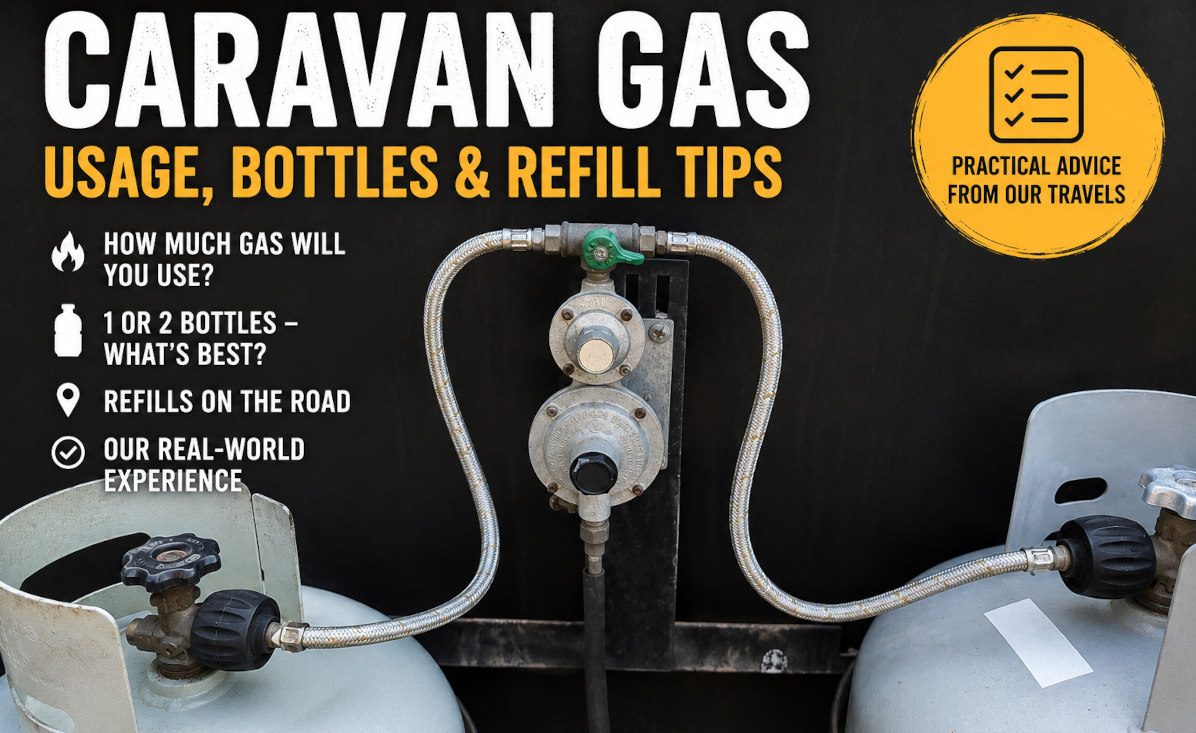
A common question is whether both gas bottles should/can be used at the same time. While systems vary, the preferred approach is to use one bottle at a time and keep the second bottle in reserve.
Our caravan uses a manual changeover valve. We run from a single bottle and keep the second bottle as a backup. When the first bottle empties, we simply switch over to the second bottle.
A good habit is to refill the empty bottle as soon as practical rather than waiting until the second bottle runs out. This ensures you always have a full reserve bottle available, which can be particularly valuable when travelling in remote areas.
This approach has several advantages, you always have a reserve supply available, and there is less risk of unexpectedly finding both bottles empty at the same time.
Adjust usage when gas matters
Small changes can stretch a bottle much further:
- Use electric hot water or cooking when on mains power
- Limit heater run time and warm the van before bed
- Cook with lids on and avoid running multiple burners
- Only heater the water in the morning
Heating is usually the biggest gas user, followed by the fridge so even small reductions there have a big impact.
Refill Options
Swap n Go (most gas stations) or BCF, Bunnings, Mitre10, Caravan Parks.
There used to be a genuinely useful LPG locator in Australia. It was called Gasmate. These days, there’s no equivalent that’s consistently accurate, so finding gas still relies on planning ahead and double-checking locally. Google is still the best option.
Summary
In our experience, gas bottles last a surprisingly long time. We often get several months from a 9 kg bottle, but our usage is fairly low.
We spend time in caravan parks, where our hot water system operates on electricity. When free camping, the hot water system runs on gas, however we typically heat the water in the morning and then switch it off. The water generally stays hot for most of the day. As a result, our gas is mainly used for the BBQ and cooktop, and with this usage pattern we typically get around two months from a 9 kg gas bottle.
When the weather turns cold, we will occasionally use the gas heater. However, our caravan is relatively small and heats up quickly, so the heater spends much of its time cycling on and off rather than running continuously.
Even so, heater use has a noticeable impact on gas consumption. During periods of moderate heater use, we typically get around one month from a 9 kg gas bottle.
Your own results may be very different. Gas consumption depends on the appliances fitted to your caravan, the climate, and your camping style. The best approach is to carry a spare bottle and keep an eye on your usage. After a while, you’ll develop a good feel for how long your gas bottles last under your typical travel conditions.
Thanks for reading Caravan Gas Bottles Explained. Shadow, the van, and the two of us will catch you at the next campsite.
If you enjoy this kind of content, you can sign up for the newsletter. You’ll get an email when a new post goes live (usually around 4–6 a month), plus a monthly wrap-up.

Leave a Reply